SERVICE & EXPERIENCE DESIGN · UT AUSTIN DESIGN STRATEGIES CAPSTONE
A map for the next step toward invention
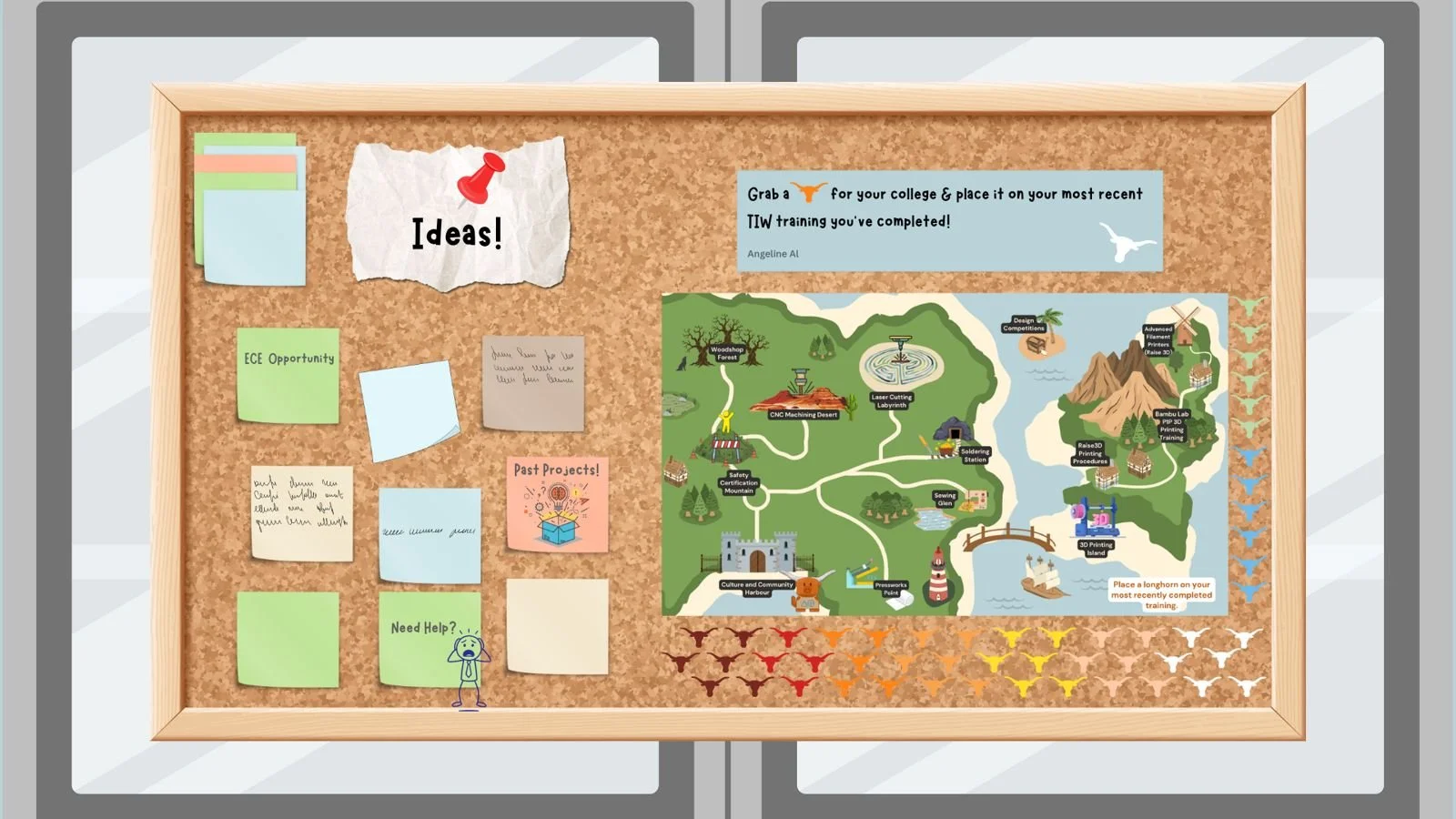
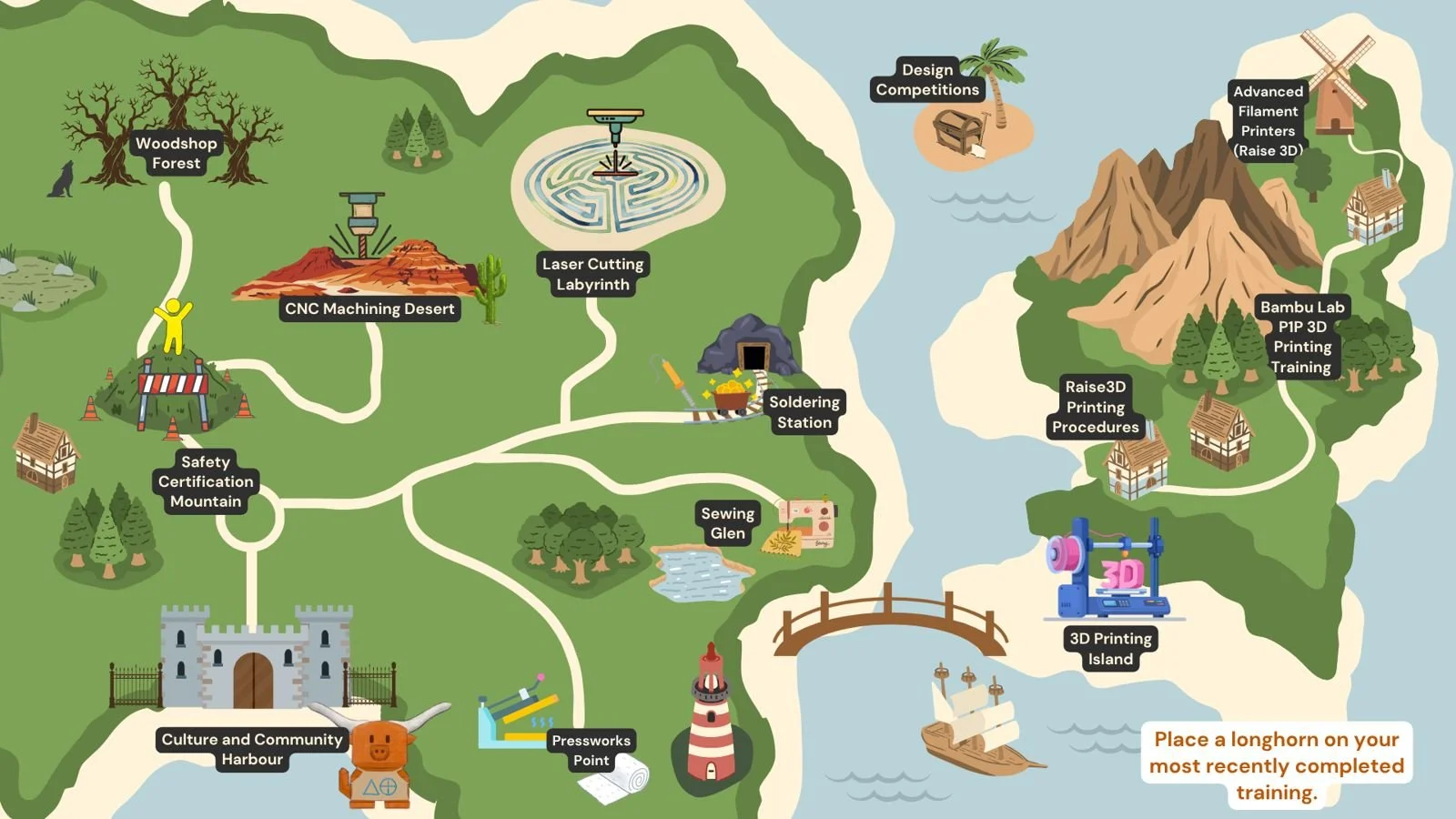
Texas Inventionworks runs a weekly makerspace party called Fab Friday. Students came for the popcorn and the small kits, then stalled out before the real machines. Our team designed a physical Adventure Map and Idea Board that show students where they are on the training path and who they could build with.
CLIENT
Texas Inventionworks, Cockrell School of Engineering
COURSE
ITD 375, Design Strategies Capstone
TEAM
5 designers from Informatics, Advertising, Art Education & Movement Science
METHODS
Field research, synthesis, Crazy 8s, physical prototyping, in-situ testing
01
ORDINARY WORLD
RESEARCH
Fab Friday was fun. It wasn't leading anywhere.
TIW director Scott Evans introduced us to Fab Friday Design Parties: LED lights, music, popcorn, personable name tags, and quick engineering tasks in the makerspace. The social energy worked. Our job was to find out what happens after the party, when a student could move on to TIW’s machine trainings and their own projects.
RESEARCH QUESTION
How might we encourage students to take the next steps towards innovation?
Guided tours
TIW and the Welch Hall Engineering Makerspace, comparing layout and points of engagement.
Fab Friday observation
Weekly visits watching how kits, example work and hallway artifacts pulled people in.
Online audit
TIW’s website, Instagram, Discord and Canvas training modules.
Empathy & group interviews
Engineering and non-engineering students, a Welch makerspace worker, and TIW leadership.
Journey mapping
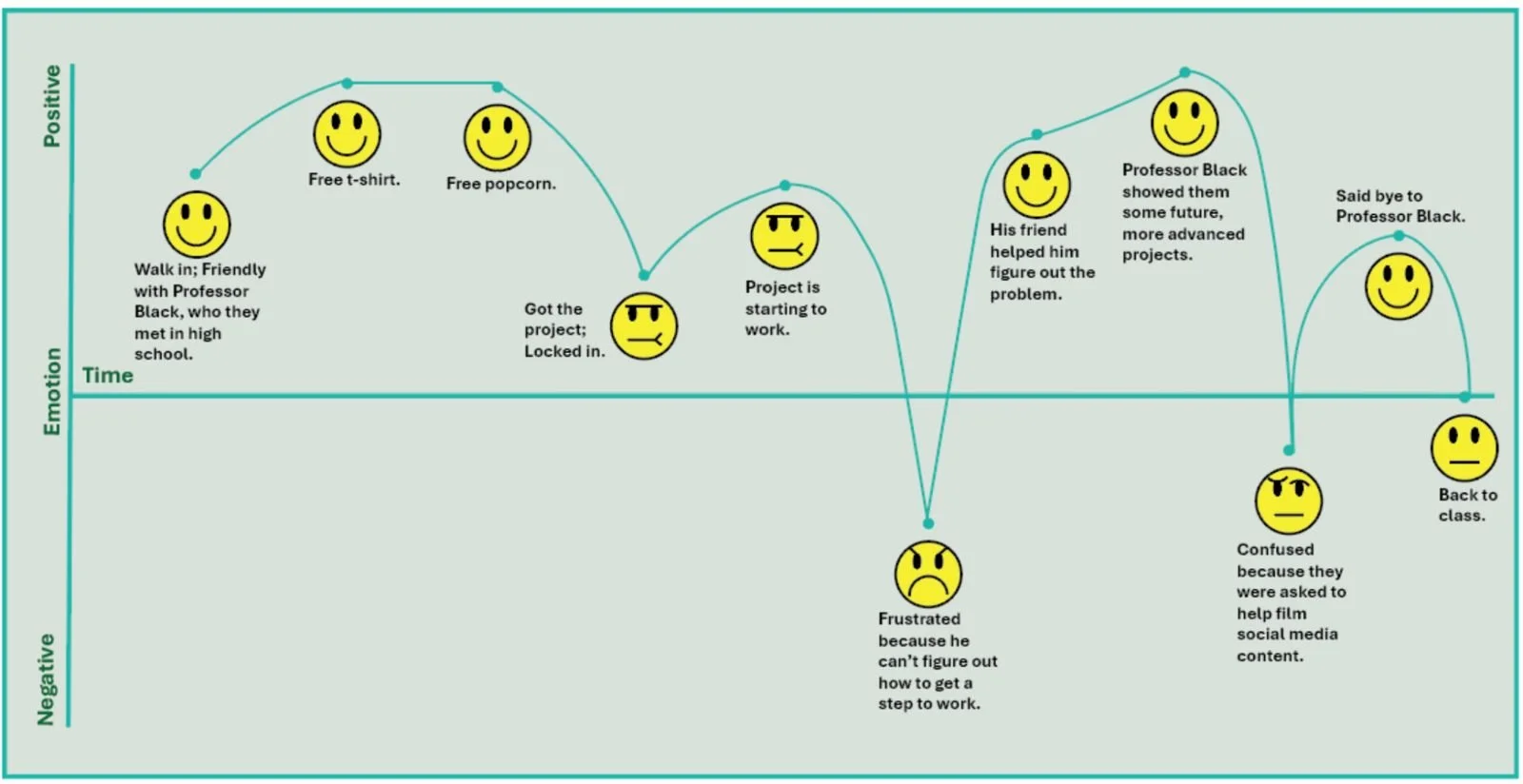
One engineering student’s emotional arc from discovering Fab Friday to finishing a project.
Secondary research
Makerspace creativity literature (Soomro et al., 2023), Dignam’s 5 C’s of Learning, blogs, news and video tours.
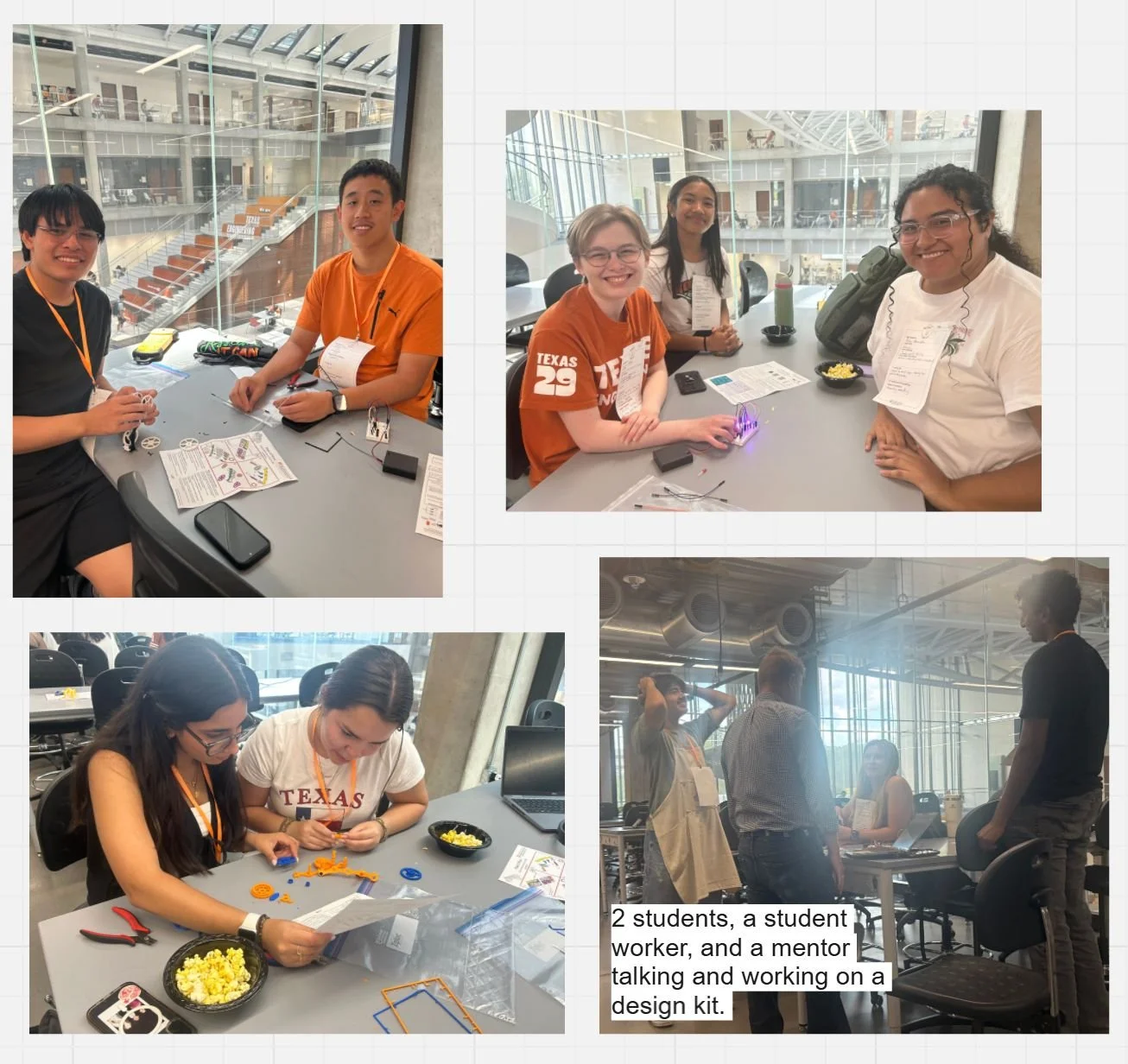
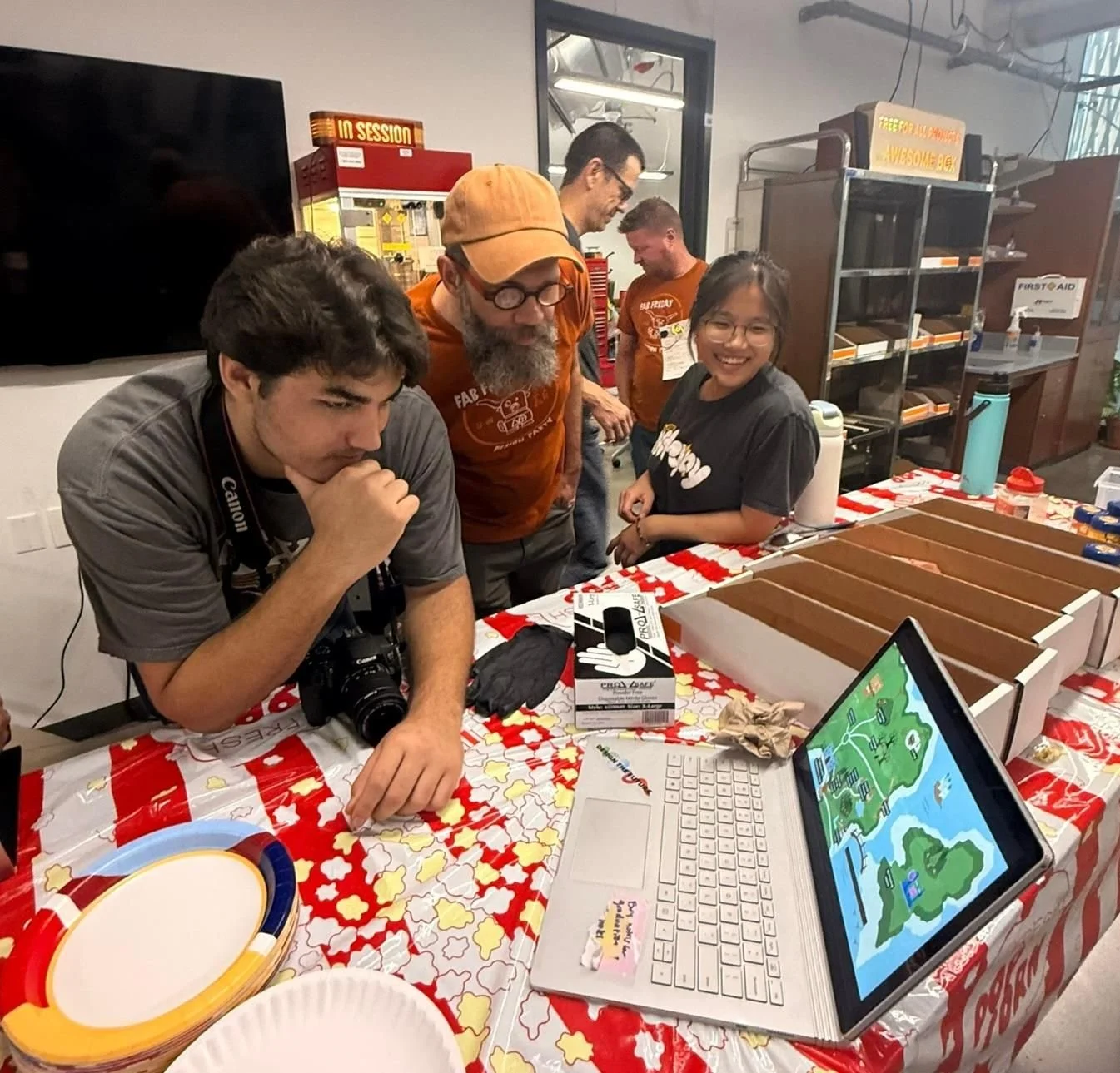
Fab Friday in progress: students, a student worker and a mentor on design kits
User journey map of an engineering student at Fab Friday, plotting moments of excitement, confusion and collaboration
STUDENTS LIKED
A low-pressure place that broke the “awkward engineer” stereotype. Some said it reminded them why they chose engineering.
STUDENTS WANTED
More collaboration and team activities, live tutorials instead of paper instructions, and time on the advanced machines.
OUTSIDE COCKRELL
Non-engineering majors didn’t know the trainings existed. Once they heard, many wanted to learn the machines.
02
CALL TO ADVENTURE
SYNTHESIS
Four themes, four insights, two missions TIW chose
We clustered our findings into four themes and wrote an insight and a “How might we” for each. We reviewed them with TIW, who prioritized the two tied to their mission: real-world impact and community.
InsightBuilding students' confidence and skillsets can motivate them to facilitate their own projects.
How might we…encourage students to participate in activities in order to build their confidence?
InsightThe more inclusive the event becomes, the more students will consistently participate.
How might we…utilize inclusivity to encourage Fab Friday participation?
InsightMakerspaces can inspire students to use their technical training to make a positive impact.
How might we…help students apply their technical skills outside of a classroom setting?
Client priority
InsightUtilizing collaboration as a means for tackling makerspace tasks enables students to connect with one another.
How might we…foster connection and community by encouraging collaboration on shared goals in makerspace settings?
Client priority
03
CROSSING THE THRESHOLD
IDEATION
The training path looked like a line. It was really a web.
We ran Crazy 8s, built on the strongest ideas with “Yes, and…”, then took them back to Fab Friday participants. Team builds and mini challenges on different machines got the most enthusiasm, so we ran rapid sprints around collaboration and hands-on making.
The turning point came from TIW’s Canvas page. Its trainings for 3D printing, laser cutting, sewing, woodshop and vinyl were listed in a straight line, implying a fixed order. Scott confirmed there wasn’t one: a student could do Woodshop without finishing Laser Cutter. The path was flexible, and nothing showed it.
CONCEPT A
Adventure Map
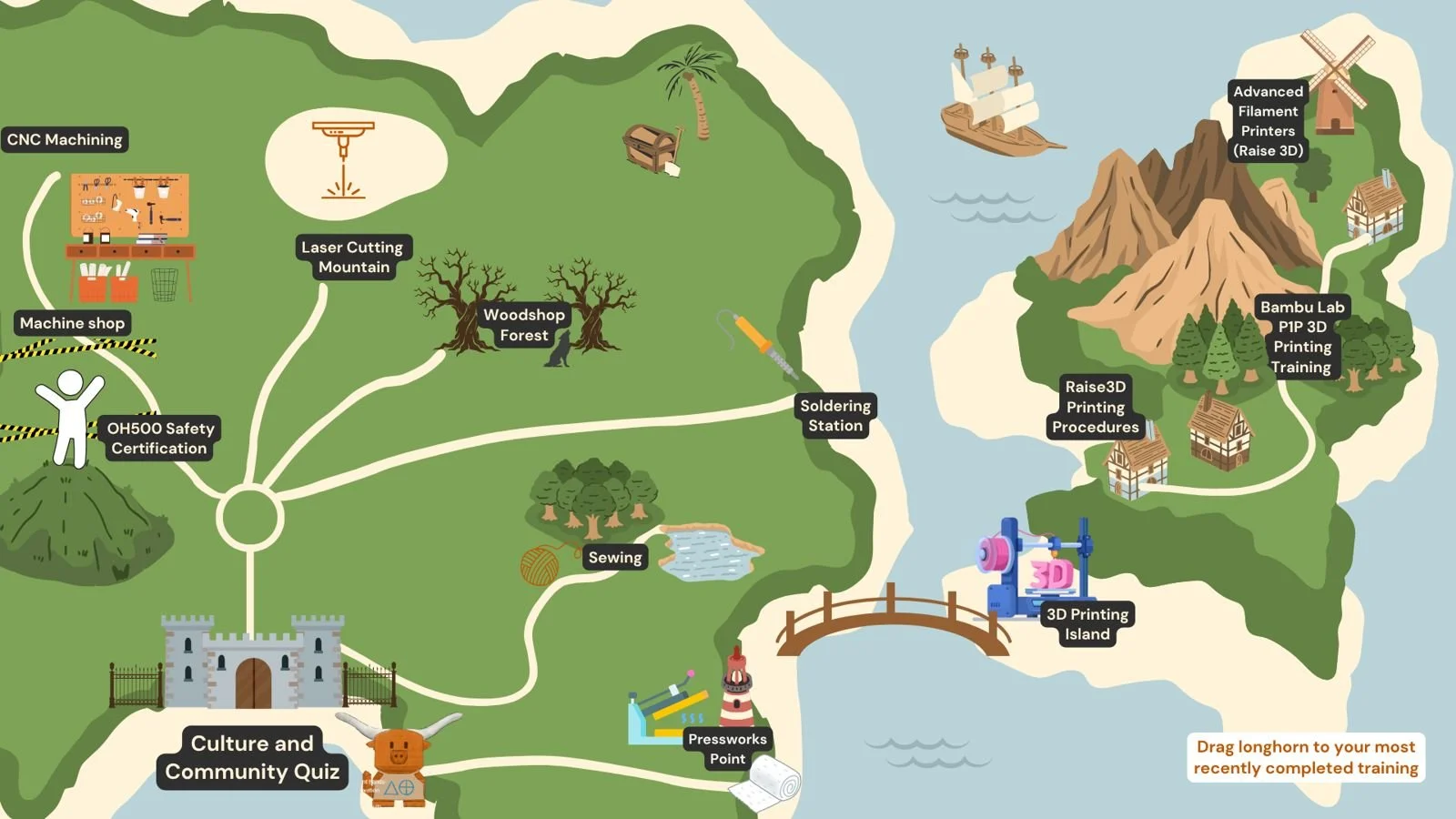
A choose-your-own-adventure map of every TIW training. Students place a pin color-coded to their college where they are now and move it as they progress. It makes the non-linear path visible, shows non-engineers what’s possible, and gives strangers something to talk about.
CONCEPT B
Idea Board
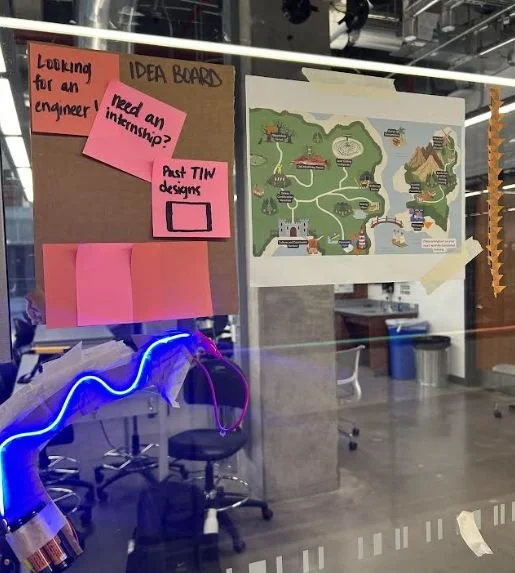
A physical board where any student can post a problem or project idea and recruit the skills they need. Scott told us about a nursing and engineering collaboration that became a company. We wanted to make that kind of match happen on purpose.
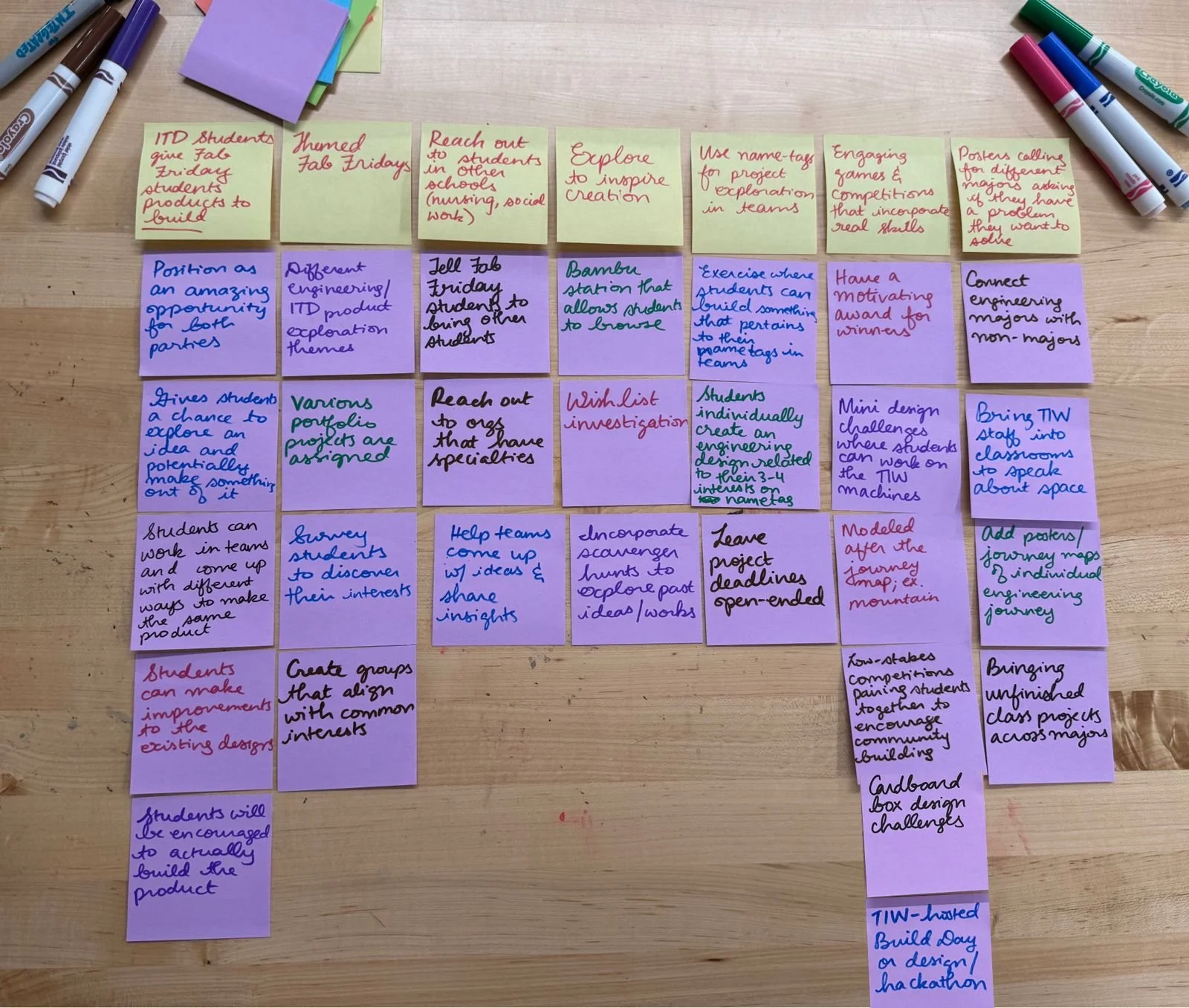
Crazy 8s and "Yes, and…" clustering
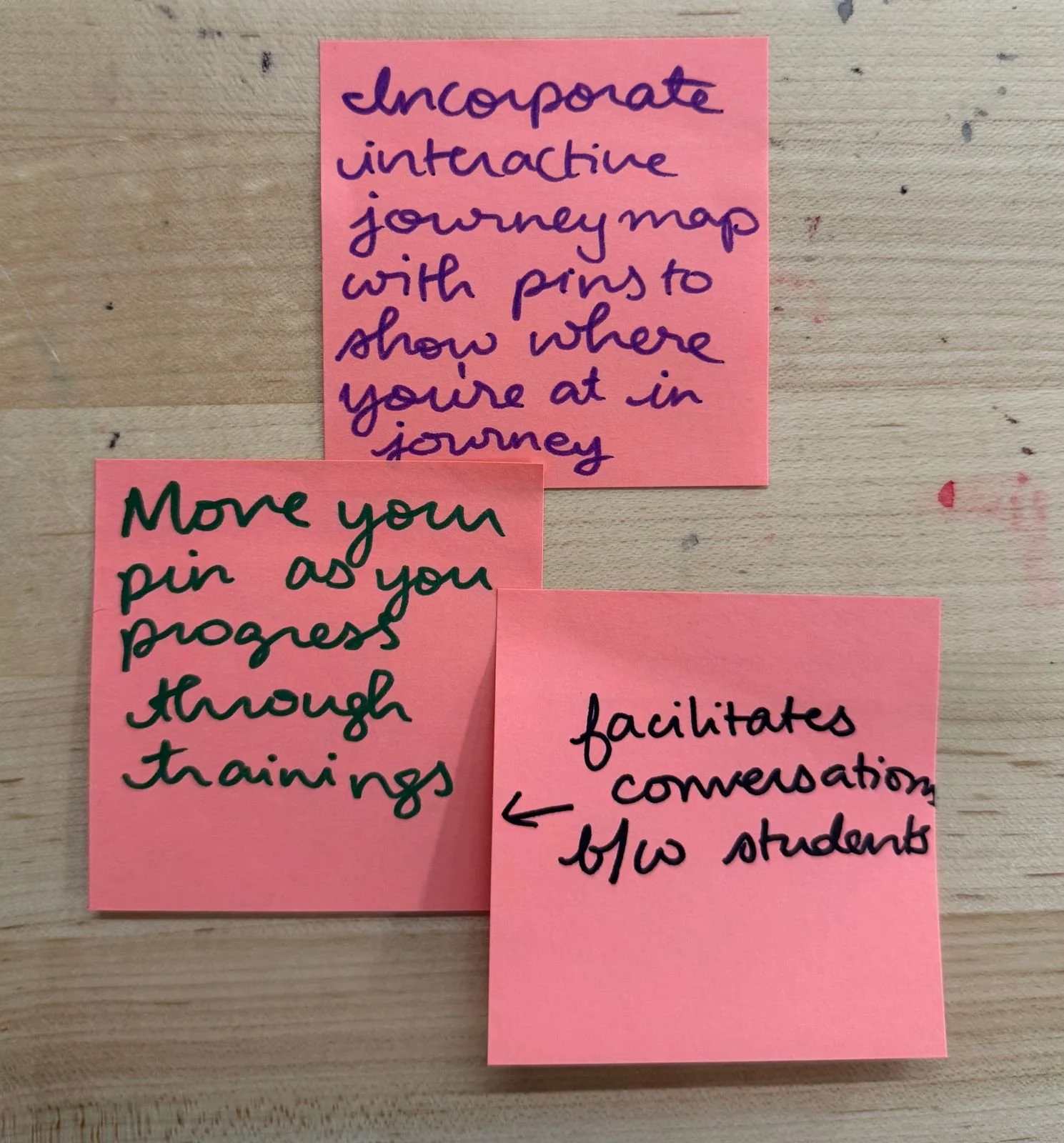
The Adventure Map Idea, first written down
04
TRIALS & ALLIES
PROTOTYPING & TESTING
We hung it on the glass and watched who stopped
We mapped each training’s prerequisites, sketched the pathways, and illustrated a low-fidelity map with each training as a destination. The Idea Board started as cardboard and sticky notes seeded with prompts like “Looking for an engineer to…” and “Need an internship?”, plus blank notes for anyone. Both went up on the glass wall outside the TIW social space during Fab Friday, next to a Likert poll.
WHAT TESTING TAUGHT US
Too small to stop anyone.
Passersby walked right by. Both pieces needed to be larger, brighter and placed where people already pause.
The map had errors only staff could catch.
Several trainings were out of order, and TIW asked for build nights, design competitions and a leaderboard.
The Idea Board needed structure.
Students weren’t sure how to use it. Scott suggested QR codes linking to past project write-ups so the board could stay uncluttered.
Make the pins physical.
A steel plate behind the map would turn the Longhorn icons into magnets students can move themselves.
IDEA BOARD
3.70
average likelihood to use, on a 1–5 scale
ADVENTURE MAP
3.28
average likelihood to use, on a 1–5 scale
MORE TRAINING?
6 yes · 0 no
“Would this motivate you to complete more training?”
05
TRANSFORMATION
ITERATION & FINAL CONCEPT
Icons students recognize, a board that glows
Students liked the progress-tracking idea but couldn’t always match an icon to its machine. We redrew the laser cutter and CNC landmarks, reordered the trainings with TIW, and filled the empty sea so the map read as one world. We mounted the Idea Board on the wall and added an LED strip to draw the eye.
The final concept is one large, colorful board. Students pin a magnet color-coded to their UT college on the training they most recently finished and move it forward as they go. Beside it, they post an idea, a problem they want solved, or a call for collaborators, and browse past TIW projects that made it off the board and into the world.
PRINCIPLES WE LEFT WITH TIW
Inspire
Students want to learn the advanced machines. They need a reason to start.
Connect
Give students with problems a place to reach people with skills, and ideas become projects.
Creative confidence
Skills plus a community of problem solvers grows confidence.
Change
New habits and mindsets spread from students to the wider community.
WHAT'S NEXT
QR codes linking to student portfolios, interactive screens, and an online archive of student inventions.
TEAM
Siena Theivagt, Melanie Vera, Hannah Forrest, Angeline Aloysius, Hannah Okafor
THANK YOU
Scott Evans and the TIW staff, our interviewees, and our professor.